The Curse of the Ordinary: Talent, Hard Work, and the Pursuit of Greatness
The Uncomfortable Truth of Talent
There’s a haunting quote from Haikyuu that echoes in my mind and probably any mind who has ever questioned their potential:
“Have you found the limits of your abilities? Even though your body, technique and mind haven’t been perfected? People who are naturally better than you, have been different from you since the day you were born.”
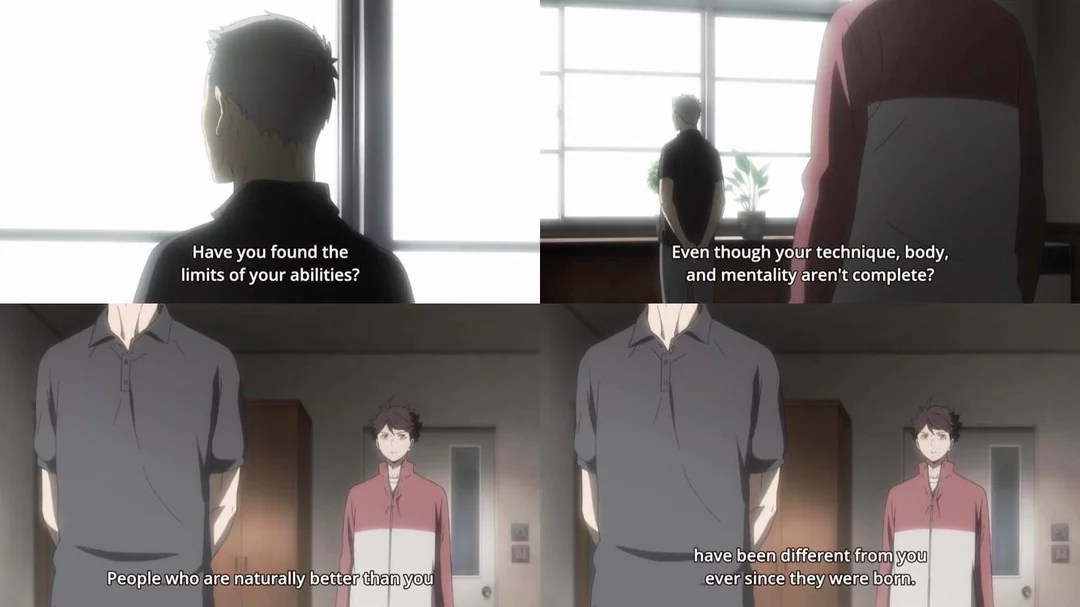
These words, spoken by an anonymous retired player in Oikawa’s flashback during the match against Karasuno, pierces deep into the heart of a fundamental human struggle, the battle between innate talent and relentless work ethic.
In the world of sports, and perhaps in life itself, there exists an unspoken hierarchy. Some are blessed with extraordinary gifts, physical prowess, lightning fast reflexes, or an intuitive understanding that seems to transcend ordinary learning. These individuals, the naturally talented, often stand at the pinnacle, making the impossible look effortless.
But here’s the uncomfortable truth: talent can be a double-edged sword.
The Paradox of Natural Ability
Many naturally gifted individuals never reach their full potential. Why? Because when something comes easily, the hunger to improve diminishes. There’s no burning necessity to push beyond comfort, to break through barriers when the baseline is already impressive.
Kobe Bryant, one of basketball’s greatest legends, understood this paradox intimately. He wasn’t the fastest, wasn’t always the most naturally talented. But what set him apart wasn’t just skill, it was an unbreakable work ethic. In his own words:
“My vertical was a 40, wasn’t a 46 or a 45. My hands are big, but they weren’t massive. I was quick, but not insanely quick. I was fast, but not ridiculously fast. I had to rely on skill, angles and studying the game more.”
When Talent Meets Work Ethic
The most terrifying scenario in any competitive field is when someone with extraordinary natural talent decides to work as hard as those without such gifts. This is the moment when true greatness is born.
In Haikyuu, Kageyama embodies this principle. Kageyama, a prodigy with incredible setter skills, learns that talent alone isn’t enough. Initially known as the “King of the Court” for his tyrannical perfectionism, Kageyama’s journey is a masterclass in transforming raw talent through relentless, obsessive improvement. He becomes fixated on every minute detail of his craft, analyzing his sets, studying team dynamics, breaking down his own movements with microscopic precision. Where once he demanded perfection from others, he now demands it of himself, spending countless hours practicing serves, perfecting his tosses, and understanding each teammate’s unique hitting style.
Kageyama’s transformation isn’t just about skill, but about emotional intelligence. He learns to adapt his setting to each player’s strengths, to communicate, to listen—turning his technical brilliance into true leadership. His obsession becomes a form of humility, recognizing that no matter how talented he is, there’s always room to grow, to understand more deeply, to become better not just as a player, but as a teammate.
In real life, athletes like LeBron James epitomize this principle as well, blessed with generational athleticism, physical dominance, and basketball IQ, yet renowned for his maniacal work ethic that goes far beyond his natural gifts.
Similarly, Michael Phelps wasn’t just born with the perfect swimmer’s body that seemed engineered for cutting through water, but complemented his genetic advantage with an unparalleled commitment to training. Cristiano Ronaldo represents another archetype: an athlete of extraordinary physical dominance who somehow still outworks everyone else, turning natural talent into legendary performance through relentless dedication.
Staying Motivated
So how does one stay motivated when the odds seem stacked against you? When you feel “ordinary” in a world that celebrates extraordinary?
Persistence, Adaptation & Failure Recovery
Natural talent might give you a head start, but it’s consistent, deliberate practice that determines your ultimate trajectory. Every day you show up, every moment you choose to push beyond comfort, that’s where real growth happens.
As Kobe would say
“I don’t want to be the next Michael Jordan, I want to be Kobe Bryant.”

The Triumph of Perseverance: Novak Djokovic’s Extraordinary Journey
In my own research into athletic mindsets, no story resonates more powerfully than that of Novak Djokovic. Tennis, perhaps more than any other sport, illustrates the battle between natural talent and relentless improvement. When Djokovic began his career, he was surrounded by two of the most naturally gifted athletes in tennis history: Roger Federer, with his surgical precision and seemingly effortless forehand, and Rafael Nadal, a physical specimen of extraordinary power and tenacity.
Yet, over the course of roughly 15 years, Djokovic didn’t just compete, he persevered. He surpassed both Federer and Nadal in Grand Slam titles, not through supernatural talent, but through an almost superhuman combination of physical discipline, mental fortitude, and an obsessive commitment to improvement. Where Federer had poetry in motion and Nadal had raw physical dominance, Djokovic developed something more profound: an ability to adapt, to learn, to push beyond perceived limitations.
His journey reached its most poignant moment with his 22nd Grand Slam victory, a triumph that transcended mere athletic achievement. Controversial, polarizing, and temporarily exiled from tournaments due to his stance during the COVID-19 pandemic, Djokovic faced more than just athletic challenges. He confronted public criticism, personal attacks, and moments that would have broken others in his position. Stripped of opportunities, vilified in media, and battling not just physical but mental challenges, he embodied resilience in its purest form.
When he clinched his 22nd Grand Slam in Australia, tying his long-term rival Rafael Nadal, it was more than a sporting victory. It was a testament to human endurance. A commentator captured the moment’s profound significance with a line that will echo through sporting history:
“He is not just the heir to greatness, he is greatness.”
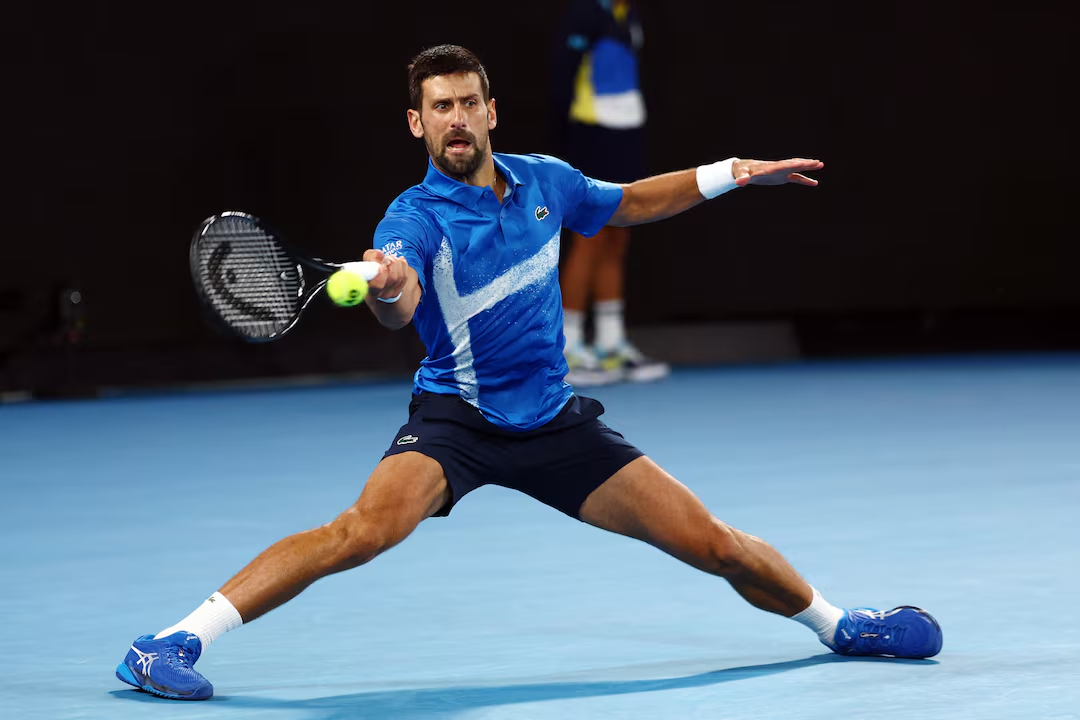
Djokovic didn’t just overcome external obstacles; he conquered the internal battles of doubt, criticism, and personal struggle.
His journey illustrates a fundamental truth: greatness is not about avoiding controversy or maintaining a perfect image, but about rising repeatedly, learning from each setback, and transforming challenges into fuel for extraordinary performance.
Final Thoughts
The “Curse of the Ordinary” is only a curse if you accept it as your fate. Talent is a gift, but hard work is a choice. And sometimes, that choice is what transforms the ordinary into the extraordinary.
Remember the question at the start: “Have you found the limits to your abilities?”
Well this is how it continues:
“Have you found the limits of your abilities? Even though your body, technique and mind haven’t been perfected? People who are naturally better than you, have been different from you since the day you were born.
No matter how hard you work, you can never change that. You can complain after you’ve done everything that you possibly can. Rather than despairing and giving up because you’re not a genius . . . believe that this isn’t the limit of your strength and continue on the path straight ahead of you. It may be a harsh road, but …”
And remember:
“Talent is something you make bloom . . . instinct is something you polish!”